

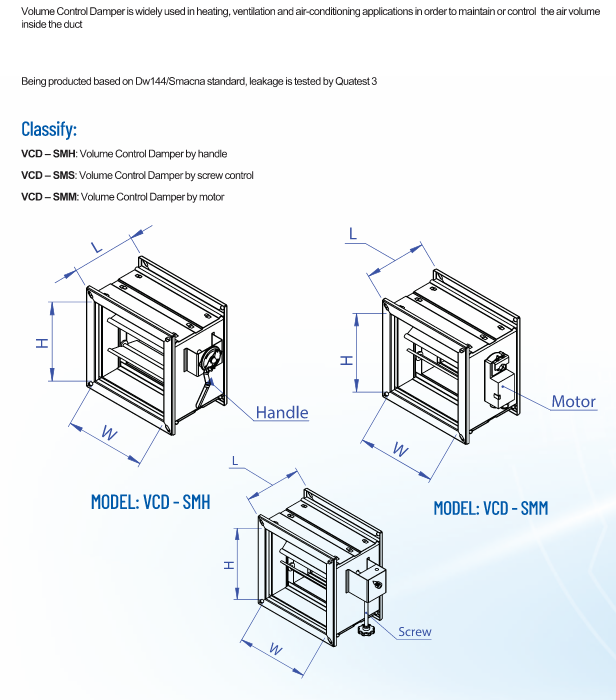
A Volume Damper (also known as a volume control damper or VCD) is a specific type of duct accessory used in heating, ventilation, and air conditioning (HVAC) systems. Its primary function is to regulate and control the volume (flow rate) of air moving through the ductwork.
Think of it like a faucet for your ventilation system—by opening or closing it, you can control exactly how much air reaches different rooms or zones in a building.
How It Works
Volume dampers consist of one or more movable blades inside a metal frame that matches the shape of your ductwork (typically round or rectangular).
-
Open Position: When the blades are parallel to the airflow, air flows freely at maximum volume.
-
Closed Position: When the blades are rotated perpendicular to the airflow, they block the air, stopping or significantly reducing the flow.
-
Modulating: The blades can be set at various angles between fully open and fully closed to fine-tune the exact amount of cubic feet per minute (CFM) of air required.
Key Types of Volume Dampers
1. By Shape
-
Round Volume Dampers: Designed to fit seamlessly into spiral or rigid round ductwork. They typically feature a single, circular butterfly blade.
-
Rectangular/Square Volume Dampers: Designed for square or rectangular ducts, utilizing multiple horizontal or vertical blades to manage air across a wider surface area.
2. By Blade Operation (Multi-Blade)
-
Opposed Blade Dampers (OBD): Adjacent blades rotate in opposite directions. This offers precise control and smoother airflow regulation, making it ideal for volume control near supply grilles.
-
Parallel Blade Dampers: All blades rotate in the same direction. These are typically used when the system requires an all-or-nothing (open/closed) function rather than fine-tuned modulation.
3. By Control Method
-
Manual Volume Dampers: Adjusted by hand using an external handle, quadrant, or lever located on the outside of the duct. Once the system is balanced during installation, these are usually locked into a permanent position.
-
Motorized/Actuated Volume Dampers: Controlled automatically by an electric or pneumatic motor (actuator). These are tied to thermostats or building automation systems to dynamically adjust airflow based on real-time temperature changes in different zones.
Why are Volume Dampers Important?
-
Air Balancing: HVAC systems naturally push more air to the ducts closest to the fan. Volume dampers are adjusted during installation to ensure that rooms further away get adequate airflow, creating a balanced and comfortable indoor environment.
-
Energy Efficiency: By restricting airflow to unoccupied zones or redirecting air where it is needed most, dampers reduce the overall workload on fans and climate control units.
-
Zoning: They allow a single large HVAC unit to serve multiple distinct zones, giving occupants independent temperature control over different floors or sections of a building.